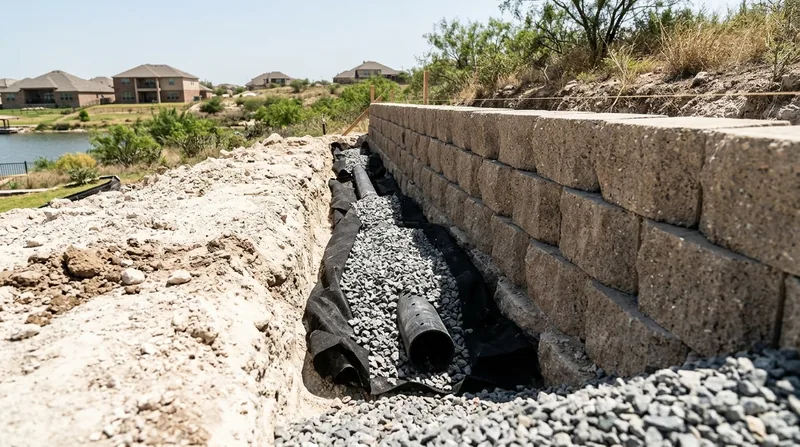




Laredo sits on the north bank of the Rio Grande where caliche ridges and expansive clay meet flash-flooding arroyos like Zacate, Chacon, and Manadas creeks. That geology is brutal on walls. Water trapped above the caliche hardpan pushes on the back of every wall, and when the clay swells after a summer storm, that pressure doubles. If you need Retaining Wall Drainage in Laredo, you need a system built for this ground, not a generic gravel trench. We install French drains, weep holes, gravel backfill, and filter fabric that move water away from the wall before it does damage. Whether your wall is split-face CMU in San Isidro, poured concrete along a driveway cut in Del Mar, or a timber wall in an older backyard, drainage is what keeps it standing. Call (956) 606-3937 for a free estimate, or review our retaining wall repair service if your wall is already showing movement.
Why Drainage Decides Whether a Laredo Wall Survives
Most retaining wall failures in Laredo start with water, not with the block or the concrete. Expansive clay swells in summer storms and shrinks in drought, and caliche hardpan traps water against the back of the wall. Add the sudden flash floods that run through the arroyos, and a wall with no relief path is under load it was never built to carry. The failure mode you see most here is the wall rotating forward at the top, cracking at the joints, and eventually leaning into the yard.
- Hydrostatic pressure builds behind the wall when water cannot escape through the backfill.
- Expansive clay swells against the wall face and pushes it out of line over a few wet seasons.
- Caliche hardpan stops downward drainage and forces water sideways into the wall base.
- Missing weep holes leave water trapped in the block cores or behind poured concrete.
- Failing timber and railroad tie walls rot faster when they sit in saturated soil.
Every one of those problems is cheaper to prevent with drainage than to fix with a replacement wall.
Key info: In the Heights and North Central, we routinely find 1950s brick homes with poured concrete walls along driveway cuts that have no weep holes and no gravel backfill. Water from the roof and the driveway runs straight into the wall, and the clay does the rest.
For the official rules on walls and grading, check the City of Laredo building department before you start any wall work above roughly four feet.
How We Build Drainage That Works in Caliche and Clay
We start by reading the ground. On a stepped lot in north Laredo or Shiloh, that means finding where the caliche shelf sits and where water actually wants to go. Then we build a drainage path that relieves the wall and carries water to daylight or to a storm outlet. We do not just dump gravel behind a wall and call it drainage.
- We excavate behind the wall and inspect the backfill, the footing, and the wall face for existing water damage.
- We install a perforated French drain at the base, wrapped in filter fabric and bedded in washed gravel.
- We core or install weep holes through the wall so water can exit at the face instead of pooling behind it.
- We backfill with free-draining gravel and filter fabric to keep clay fines out of the drain over time.
- We tie the outlet into a swale, a pop-up emitter, or a storm line so the water leaves the wall zone.
- We test the system with a controlled flow before we close the trench and restore the surface.
That sequence is what separates a drainage repair that lasts from one that fails in the next wet season.
Key info: A homeowner in Rio Bravo had a segmental block wall along the property line that leaned six inches after two summers of storms. The block was fine. The wall had no drain and no weep holes, and the clay had pushed it out of plumb. We relieved the pressure, reset the wall, and added a French drain with a daylight outlet.
If your wall is already leaning, see our leaning and collapsed wall repair service before the drainage work begins.
Drainage Approaches We Use on Laredo Walls
Not every wall needs the same system. A garden wall in the San Agustín historic barrio and a tall CMU wall holding grade between stepped lots in the north need different solutions. We match the approach to the wall type, the soil, and where the water can go.
| Approach | Description | Best for |
|---|---|---|
| French drain behind wall | Perforated pipe in washed gravel, wrapped in filter fabric, running the length of the wall base. | Most block, concrete, and timber walls with active water pressure. |
| Weep holes and face drains | Cored openings through the wall face that let water exit instead of pooling in the cores. | CMU, poured concrete, and segmental block walls without existing relief. |
| Gravel backfill and filter fabric | Free-draining stone behind the wall with fabric to keep clay fines out of the drain. | New walls and repairs where the original backfill was clay or caliche spoil. |
| Surface swale and grading | Regrading the yard above the wall so runoff goes around the wall, not into it. | Sloped lots in north Laredo and Shiloh where runoff concentrates at the wall. |
| Downspout and roof water control | Extending gutters and downspouts away from the wall zone to cut the water load. | Homes where roof runoff dumps directly behind a retaining wall. |
Retaining Wall Drainage Cost in Laredo: What to Expect
Drainage work starts at From $2,500 for a typical residential wall, and that figure covers the drain line, gravel, filter fabric, weep holes, and outlet. The final number depends on wall length, how deep we have to excavate, whether the wall needs partial reset, and how far the water has to travel to a daylight outlet. A short wall in Del Mar with an easy outlet sits near the starting figure. A long tiered wall in the north with caliche to cut through and a storm line tie-in runs higher.
Get two or three estimates and compare the scope, not just the price. A low number that skips the filter fabric or the outlet is not a real drainage job. You can review our full pricing overview for the range of wall and drainage work we handle.
What to Look for When Hiring a Retaining Wall Contractor Near Laredo
Drainage work is easy to fake. Anyone can dump gravel behind a wall. Look for a contractor who can explain where the water goes, who carries insurance, and who will show you references from walls similar to yours. Ask about permits if the wall is above roughly four feet or holds a driveway or structure, and confirm the contractor knows the local building department requirements.
- Confirm the contractor is fully insured and ask for a certificate before work starts.
- Get at least three written estimates with the drainage scope spelled out.
- Ask for references from Laredo walls of the same type and height as yours.
- Check whether a permit is required and who pulls it for walls over the local threshold.
- Ask how the outlet will work and where the water will actually go.
If you are ready to talk through your wall, contact us for a free estimate and we will walk the site with you.
Retaining Wall Drainage Near Me: What Laredo Homeowners Should Know
When you search for retaining wall drainage near me in Laredo, you will find plenty of contractors who pour concrete and stack block. Fewer specialize in the drainage side, which is where most wall failures start. We focus on relieving water pressure in clay and caliche, and we see the same failure pattern across the city: walls built without relief, then blamed on the material when they lean.
Our work is backed by NCMA Segmental Retaining Wall Installer Certification, and we are fully insured. If your wall is in the historic barrios, the Heights, or a newer subdivision in the north, the drainage principles are the same even when the wall material changes. Call (956) 606-3937 and we will tell you what your wall needs.
Retaining Wall Drainage in Laredo: Pricing Guide
| Service | Price | Details |
|---|---|---|
| French drain behind existing wall | Starting at $2,500 | Includes drain line, washed gravel, filter fabric, weep holes, and outlet for a typical residential wall. |
| Weep holes and face drainage | Starting at $2,500 | Coring and installing relief openings through CMU or concrete, priced by wall length and access. |
| Full drainage retrofit with regrading | Starting at $4,500 | Adds surface swale, downspout control, and partial wall reset where the wall has already moved. |
| Tiered or tall wall system | On estimate | Tiered walls and walls over four feet need an on-site look at caliche depth and outlet options. |
| Travel | Included | In Laredo and surrounding areas, no separate call-out or mileage fee. |
| Estimate | Free | Response within 24h at (956) 606-3937, no obligation to book. |
Indicative pricing, the exact cost depends on square footage, finish, and site access. Free personalized estimate within 24h at (956) 606-3937.


