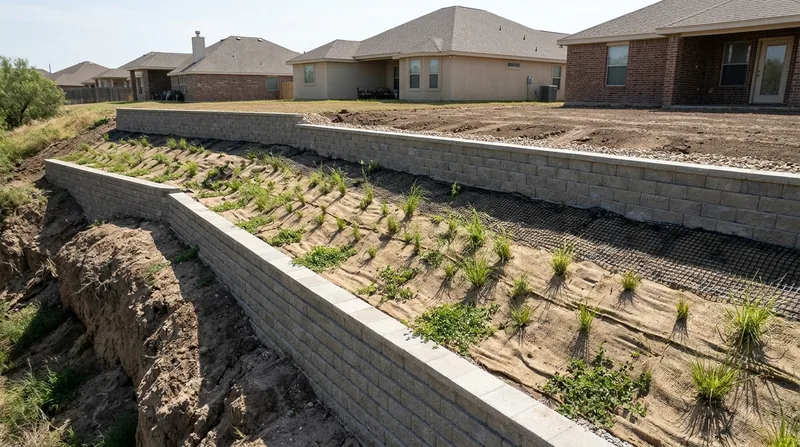




Laredo sits on the north bank of the Rio Grande where caliche ridges and expansive clay meet flash-flooding arroyos like Zacate, Chacon and Manadas creeks. Along the river bluffs and in the stepped subdivisions of north Laredo, a slope that loses its cover can move fast in a single storm. That is why Slope Stabilization & Erosion Control in Laredo starts with reading the ground: the soil, the grade, the water path and what sits above and below it. We build terraced walls, geogrid reinforcement and drainage systems that hold hillsides in place for homes in San Isidro, Alexander, Shiloh and the historic barrios. Whether your yard is sliding toward an arroyo or a bluff is undercutting a driveway, we stop the movement and protect the structure. For walls that are already leaning or cracked, see our leaning and collapsed wall repair service.
Why Slope Stabilization Matters on Laredo's Caliche Ridges and River Bluffs
The clay under much of Laredo swells in summer storms and shrinks in drought, so slopes that look stable in August can crack and slump by the next spring. Caliche hardpan traps water above it, and when a flash flood hits an arroyo bank, the soil lets go in chunks. Add 100-degree heat that bakes the surface and you get the failure mode we see most: shallow surface sliding and bank undercutting after heavy rain.
- Expansive clay pushes retaining walls out of line and opens cracks in driveways above slopes.
- Flash floods scour arroyo banks and undermine footings along Zacate and Chacon creeks.
- River bluffs along the Rio Grande lose soil where brush clearing left bare ground.
- Stepped lots in north Laredo concentrate runoff against the uphill side of walls.
- Drought cracks let water penetrate deep into the slope during the next storm.
We address the cause, not just the symptom, so a repaired slope stays put through the next monsoon season.
Key info: In a Laredo neighborhood off Mines Road, a homeowner lost six feet of backyard in one storm when runoff from a caliche ridge poured over a bare arroyo bank. A terraced wall with geogrid and a drainage swale stopped the movement and saved the fence line.
For local permit thresholds on walls and grading, check the City of Laredo Building Department before work starts: cityoflaredo.com/building.
How We Stabilize Slopes in Laredo, Step by Step
Every slope job starts with a site visit and a look at the water. We check the soil, the grade, the drainage path and any structures within influence. Then we build a plan that fits the site: terraced walls, geogrid, surface drainage, or a combination. We schedule around the dry windows and protect the slope during construction.
- We walk the slope and mark the failure zones, water paths and property lines.
- We test the soil and confirm the depth of caliche and expansive clay.
- We design the wall heights, tier spacing and geogrid layout for the load.
- We excavate and shape the slope to the designed grade.
- We install drainage, geogrid and the retaining structure.
- We restore surface cover and seed or mulch to control erosion.
We finish with a walkthrough so you know what to watch and how to maintain the slope.
Key info: On a stepped lot in the Shiloh area, runoff from the upper lot was pouring against a CMU wall between terraces. We regraded the upper yard, added a swale and tied the wall into a geogrid-reinforced slope. The wall has stayed plumb through two storm seasons.
We also handle the drainage side of the work, which you can review on our retaining wall drainage page.
Slope Stabilization Methods We Use in Laredo
We match the method to the slope, the soil and the load above it. A river bluff with a house at the top needs a different approach than a backyard bank along an arroyo. The table below shows the main approaches we use in Laredo and the conditions each one fits.
| Approach | Description | Best for |
|---|---|---|
| Terraced retaining walls | Stacked walls with set-back tiers that break up slope height and reduce load on each wall. | Stepped lots in north Laredo and hillside yards with limited space. |
| Geogrid reinforcement | Layers of high-strength mesh tie the wall to the soil mass behind it. | Tall walls, surcharge loads and expansive clay slopes. |
| Surface drainage and swales | Graded channels that move storm runoff away from the slope face. | Caliche ridges that shed water onto lower lots. |
| Erosion control blankets and seeding | Temporary and permanent cover that holds topsoil until vegetation establishes. | Bare arroyo banks and newly graded slopes. |
| Boulder toe protection | Rock placed at the base of a slope to absorb scour from flowing water. | River bluffs and arroyo edges along the Rio Grande. |
We choose the combination based on the site, and we explain the trade-offs before you commit.
Slope Stabilization & Erosion Control Cost in Laredo: What to Expect
Every slope stabilization job starts with a free estimate, because the number depends on the site. Slope height, soil depth, access for equipment, and whether a structure sits above the slope all move the price. So does the method: a geogrid-reinforced wall costs more than surface drainage and seeding, but it holds a taller slope. We give you a written scope and a clear number before work begins.
Getting two or three estimates is smart on any slope job. Ask each contractor what failure mode they are addressing and how they will handle water. A low bid that skips drainage usually costs more later. You can review typical ranges on our pricing page and then call us for a site-specific number.
We serve homeowners across Laredo, from the historic barrios to the new subdivisions on the north side, and we price the work to the actual site conditions.
What to Look for When Hiring a Retaining Wall Contractor Near Me in Laredo
Hiring for slope work is different from hiring for a flat-lot wall. You want a contractor who reads water and soil, not just one who stacks block. Ask how they handle drainage, what they do about expansive clay, and whether they will put the scope in writing. Then check the basics below before you sign.
- Confirm the contractor is fully insured and ask for a certificate before work starts.
- Get two or three written estimates with the same scope so you can compare fairly.
- Ask for references from jobs on slopes similar to yours, not just flat lots.
- Check permit requirements with the City of Laredo for walls over the local threshold.
- Ask how they will protect mesquite, huisache and ebony trees you want to keep.
- Review any HOA rules for wall height, materials and setbacks before you build.
We are happy to walk you through our scope and references, and you can reach us through our contact page to schedule a free estimate.
Key info: In the Heights, a homeowner got three bids for a failing timber wall at the top of a slope. The lowest bid skipped drainage. The chosen contractor added a swale and geogrid, and the wall has stayed put through two rainy seasons.
We bring NCMA Segmental Retaining Wall Installer Certification to every slope job, and we put the plan in writing so you know exactly what you are getting.
Slope Stabilization & Erosion Control in Laredo: Pricing Guide
| Service | Price | Details |
|---|---|---|
| Slope inspection and stabilization plan | Free estimate | On-site review of slope, soil, drainage and structures, with a written scope and fixed price. |
| Surface erosion control and seeding | Starting at $1,200 | Grading, erosion blanket and seed for low banks; price rises with slope height and access. |
| Terraced retaining wall with geogrid | Starting at $4,500 | Engineered wall with drainage and reinforcement; cost moves with wall height and soil depth. |
| River bluff or arroyo bank stabilization | On estimate | Bluff and bank work needs an on-site look at scour, access and load above the slope. |
| Travel | Included | In Laredo and surrounding areas, no separate call-out or mileage fee. |
| Estimate | Free | Response within 24h at (956) 606-3937, no obligation to book. |
Indicative pricing, the exact cost depends on square footage, finish, and site access. Free personalized estimate within 24h at (956) 606-3937.


