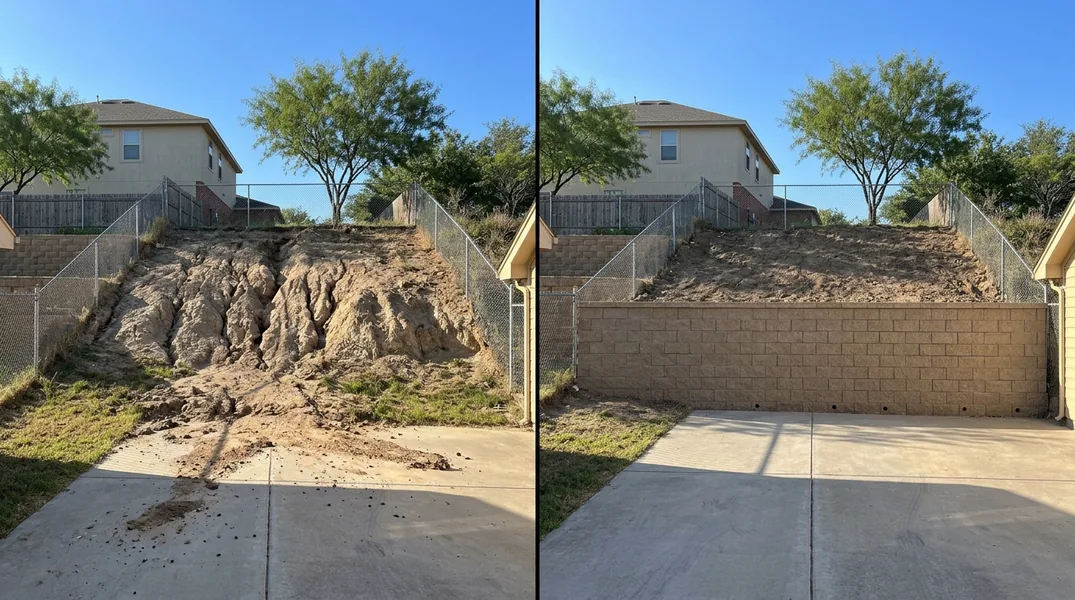
Why South Texas Soil Changes Everything for Retaining Walls
If you live in Laredo, you already know that the ground here is not like the soil in other parts of Texas. The combination of expansive clay and caliche creates a unique set of challenges for any structure that has to hold back earth. Clay swells dramatically when it absorbs water after a heavy rain, then shrinks and cracks during the long dry stretches. Caliche, that dense layer of calcium carbonate, can be so hard that digging into it feels like chipping concrete. Together, they put enormous pressure on a wall and make proper drainage absolutely essential.
This is why the material you choose for a retaining wall matters so much more here than it might in a milder climate. A wall that looks fine on paper can fail within a few seasons if it cannot handle the movement and hydrostatic pressure that South Texas soil generates. Homeowners researching options often focus on appearance, but the smartest approach is to match the material to the soil conditions first, then think about aesthetics. The four main choices, concrete, block, limestone, and segmental systems, each behave differently in this environment, and understanding those differences will help you make a decision you will not regret.
Concrete Retaining Walls: Strength for Heavy Clay Loads
Concrete Retaining Walls are the heavyweight champion when it comes to resisting the pressure that expansive clay can generate. Poured concrete is monolithic, meaning it acts as a single continuous structure rather than a collection of individual pieces. That continuity helps it stand up to the shifting and swelling that clay undergoes throughout the year. For taller walls or situations where the soil behind the wall is especially active, reinforced concrete is often the most reliable choice available.
The tradeoff is that concrete requires proper engineering and careful construction. It needs a solid footing, correct steel reinforcement, and well-planned weep holes and drainage. When those details are handled correctly, a concrete wall can last for decades with minimal maintenance. Homeowners who want a clean, modern look sometimes prefer the smooth finish of concrete, while others add a veneer later to soften the appearance. If your property has a steep slope or a significant load to hold back, concrete deserves serious consideration, and it is worth discussing with a professional who understands local soil behavior.
Block Retaining Walls: A Versatile Middle Ground
A Retaining Wall Installation using block offers a practical balance between strength and flexibility. Block walls are built from individual units that interlock or are mortared together, and they can be engineered to handle substantial loads when properly designed. The modular nature of block means the wall can accommodate slight movements without catastrophic failure, which is a real advantage in soil that shifts as much as ours does. Block also comes in a wide variety of colors, textures, and sizes, so it is easier to match the look of your home or landscaping.
One thing to keep in mind is that block walls depend heavily on good construction practices. The base course must be level and compacted, the drainage gravel and filter fabric must be installed correctly, and the wall needs proper backfill. In caliche-heavy areas, excavation can be slow and costly, so a contractor who knows the local ground conditions will save you time and frustration. Block is a popular choice for mid-height walls, terraced designs, and situations where homeowners want a traditional masonry look without the cost of full concrete construction.
Limestone Retaining Walls: A Natural Fit for South Texas
A Retaining Wall Repair specialist will tell you that material choice affects how easy a wall is to maintain over time, and limestone is one of the most forgiving natural options. Limestone is abundant in this part of Texas, and its earthy, warm tones blend beautifully with the local landscape. It is heavy, durable, and resistant to the seasonal moisture swings that punish lesser materials. For garden walls, low retaining walls, and decorative terracing, limestone delivers a look that feels authentic to the region.
Limestone walls are typically built as gravity walls, meaning they rely on their own mass to hold back the soil. That works well for shorter walls, but taller limestone walls need careful engineering and may require reinforcement or a concrete core. The stone is also porous, so proper drainage behind the wall is critical to prevent water from building up and pushing the structure forward. Homeowners in Rio Bravo and similar communities often choose limestone because it looks natural, ages gracefully, and stands up to the harsh sun and occasional downpours.
Segmental Retaining Walls: Modern Engineering Meets Curb Appeal
Retaining Wall Replacement projects frequently turn to segmental retaining walls because these systems are engineered specifically for stability. A segmental wall is built from precast concrete blocks that interlock and often use geogrid reinforcement to tie the wall into the soil behind it. This design distributes pressure across a wider area and allows the wall to handle significant loads while remaining relatively thin and space-efficient. For homeowners who want a strong wall without a massive concrete footprint, segmental systems are an excellent option.
Segmental walls also offer excellent design flexibility. The blocks come in many shapes and finishes, from smooth and contemporary to textured and rustic, so you can achieve the look you want while benefiting from modern engineering. They are particularly well suited to terraced landscapes and walls that follow curved property lines. Because the system relies on proper compaction and geogrid placement, installation quality is everything. A wall built without those details can settle or bulge, especially in clay soil. When installed correctly, a segmental wall can provide decades of reliable service and strong curb appeal.
Retaining Wall Installation Cost in Laredo: What to Budget
Understanding pricing before you commit helps you plan realistically and compare bids with confidence. The cost of a retaining wall in Laredo depends on several factors: the height and length of the wall, the material you choose, the difficulty of excavation in caliche, and whether engineering or permits are required. Concrete and engineered segmental walls tend to cost more upfront because of materials and reinforcement, while limestone and block can be more budget-friendly for shorter, decorative walls. However, the cheapest option is not always the best value if it fails early.
Excavation is often the wild card in this region. Caliche can slow down digging considerably, and contractors may need special equipment to get through it. That is one reason local experience matters so much when you request a free estimate. A contractor who has worked in El Cenizo and across the Laredo area will know what to expect and can give you a more accurate number. Ask for a written scope that includes drainage, backfill, and compaction, because those items are not optional extras. They are what keeps your wall standing.
Retaining Wall Installation Near Me: When to Call a Pro
Some landscaping projects are friendly to do-it-yourselfers, but retaining walls are rarely one of them, especially in South Texas. The combination of expansive clay, caliche, and seasonal downpours means a wall must be designed and built to manage water and pressure correctly. A small mistake in the base, drainage, or reinforcement can lead to settling, leaning, or outright failure, and repairing a failed wall often costs more than building it right the first time. If your wall is taller than about three feet, holds back a slope near a structure, or shows signs of movement, it is time to bring in a professional.
Laredo Retaining Wall serves homeowners throughout the Laredo area with material selection, installation, repair, and replacement. Whether you are considering a limestone garden wall, a segmental system for a terraced yard, or a reinforced concrete wall for a serious slope, the team can help you weigh the options and choose what works for your soil and budget. Call (956) 606-3937 to discuss your project or to schedule a free estimate. Getting expert eyes on your site early is the best way to avoid costly surprises later.
Looking for a professional retaining wall contractor in Laredo? Laredo Retaining Wall responds fast for all your retaining wall needs.
Get a Free QuoteOur services: Retaining Wall Installation · Retaining Wall Repair · Retaining Wall Replacement