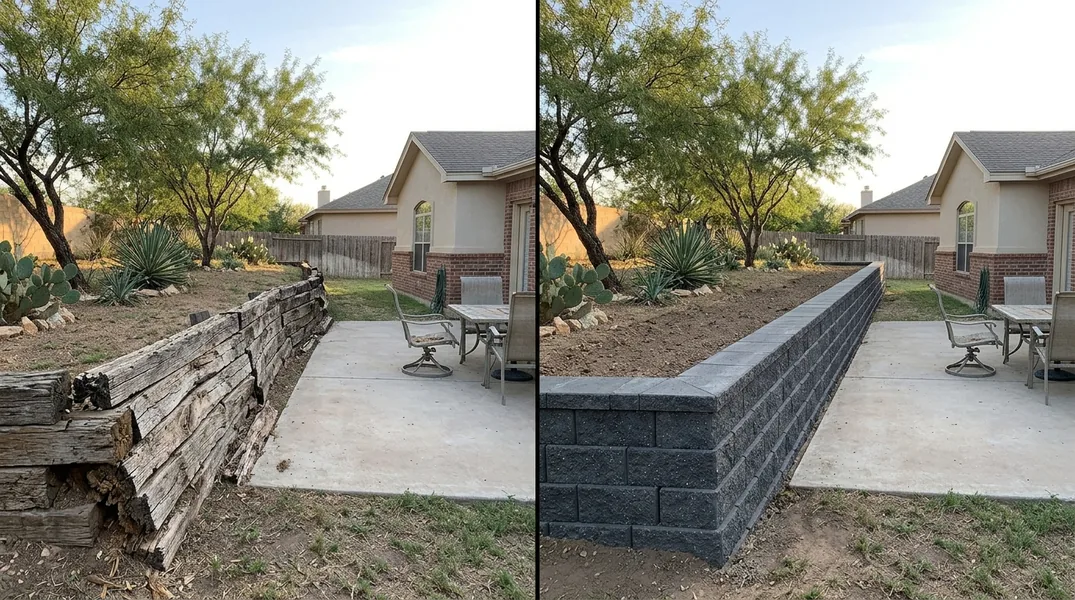
Why Laredo Flash Floods Are So Hard on Retaining Walls
If you live in Laredo, you already know how fast the weather can turn. A dry, dusty afternoon can become a torrential downpour in minutes, and the flat, clay-heavy soil around many homes does not absorb water quickly. Instead, runoff sheets across yards and pools behind any obstruction, including the retaining wall holding up your landscaping or driveway. That sudden surge is exactly the kind of event that exposes weak retaining wall drainage.
Most homeowners focus on the visible part of a wall: the block, stone, or concrete face. But the real battle happens underground. When water cannot escape, it saturates the backfill soil and pushes against the wall from behind. This is called hydrostatic pressure, and it is the single most common reason retaining walls fail during flash floods. A wall that looks perfectly fine in dry weather can crack, lean, or collapse after one intense storm if its drainage system was never designed for Laredo's monsoon-style rain.
How Hydrostatic Pressure Builds Behind a Wall
Think of a retaining wall as a dam holding back soil. In dry conditions, that soil is heavy but relatively stable. Once a flash flood dumps inches of rain in a short time, the soil behind the wall turns into a saturated, muddy mass. Water fills every pore space, and because it has nowhere to go, it exerts enormous sideways force. This is hydrostatic pressure retaining wall failure in action. The pressure can easily double or triple the load the wall was designed to handle.
Walls are engineered to resist soil weight, not water weight. When hydrostatic pressure spikes, the wall begins to bow outward, mortar joints crack, and the footing can shift. On block walls, you may notice stair-step cracks or a lean that gets worse each rainy season. On concrete walls, you might see horizontal cracking or separation at the base. By the time these symptoms appear, the damage is often advanced. That is why proper drainage is not an optional add-on. It is the difference between a wall that lasts decades and one that fails in a single storm.
The Role of a Retaining Wall French Drain
The most reliable way to relieve hydrostatic pressure is a retaining wall french drain. This system typically consists of a perforated pipe wrapped in filter fabric and surrounded by gravel, installed at the base of the wall behind the backfill. When groundwater rises, it enters the pipe and is carried away to a safe discharge point, such as a storm drain or a graded swale. A properly built french drain keeps the soil behind the wall from ever becoming saturated enough to threaten the structure.
Unfortunately, many older walls in Laredo were built with little or no drainage. Some have a weep hole or two, which is nowhere near enough for a flash flood. Others have a drain that has clogged with silt and roots over the years. If your wall has no visible drainage or you see water seeping through the face during storms, it is worth having a professional inspect it. Ignoring a failing drain is like ignoring a leak in your roof: the damage compounds quietly until it becomes expensive. If you suspect drainage problems, a Retaining Wall Repair assessment can identify whether the drain can be restored or must be rebuilt.
Warning Signs Your Retaining Wall Drainage Is Failing
Homeowners often ask how to tell if a wall is in trouble before it collapses. The signs are usually visible if you know where to look. Water pooling at the base of the wall after rain, soil washing out from behind the structure, or a white powdery stain on the face (efflorescence) all point to poor drainage. You may also notice that the wall leans slightly, that gaps open between blocks, or that the ground behind the wall has settled into a depression. Any of these mean water is not moving where it should.
In Rio Bravo and other nearby communities, the soil conditions are similar, and the same warning signs apply. Do not wait for a wall to actually fail. A leaning wall is a safety hazard, especially if it supports a driveway, pool deck, or children's play area. A professional inspection can tell you whether the drainage can be improved with a new french drain and weep holes or whether the wall needs more extensive work. For walls that are already compromised, Retaining Wall Replacement may be the safer and more cost-effective path.
Retaining Wall Installation Near Me: Getting Drainage Right the First Time
The best defense against flash flood damage is a wall designed and built with drainage as a priority. That means proper backfill material, a gravel drainage zone, filter fabric to keep silt out of the pipe, and a discharge point that carries water away from the wall and the house. It also means using materials suited to the load and the climate. Concrete Retaining Walls are popular in the Laredo area because they handle heavy loads well and can be reinforced to resist pressure, but even concrete needs a working drain behind it.
If you are planning a new wall, ask your contractor specifically how they will handle water. A good installer will explain the drainage plan before any block is laid. If you are searching for retaining wall installation near me and want a team that understands local soil and storm patterns, call Laredo Retaining Wall at (956) 606-3937. We build walls that are engineered to shed water, not just hold back dirt, and we serve homeowners throughout the area, including El Cenizo and Bruni.
Protecting Your Investment: Maintenance and When to Call a Pro
Even a well-built wall benefits from occasional maintenance. Keep the area around the wall clear of debris, and make sure downspouts and gutters route water away from the structure. Check the discharge point of your french drain after heavy storms to confirm water is flowing freely. If you see erosion or settling, address it early. Small fixes are far cheaper than rebuilding a failed wall, and they protect the landscaping and structures the wall was built to support.
If you are unsure about the condition of your wall, or if you are planning a new project and want to understand pricing, reach out for a free estimate. Laredo Retaining Wall can evaluate your drainage, recommend repairs or a new build, and give you a clear picture of what it will take to keep your wall standing through the next flash flood. Call (956) 606-3937 to schedule your assessment.
Looking for a professional retaining wall contractor in Laredo? Laredo Retaining Wall responds fast for all your retaining wall needs.
Get a Free QuoteOur services: Retaining Wall Installation · Retaining Wall Repair · Retaining Wall Replacement