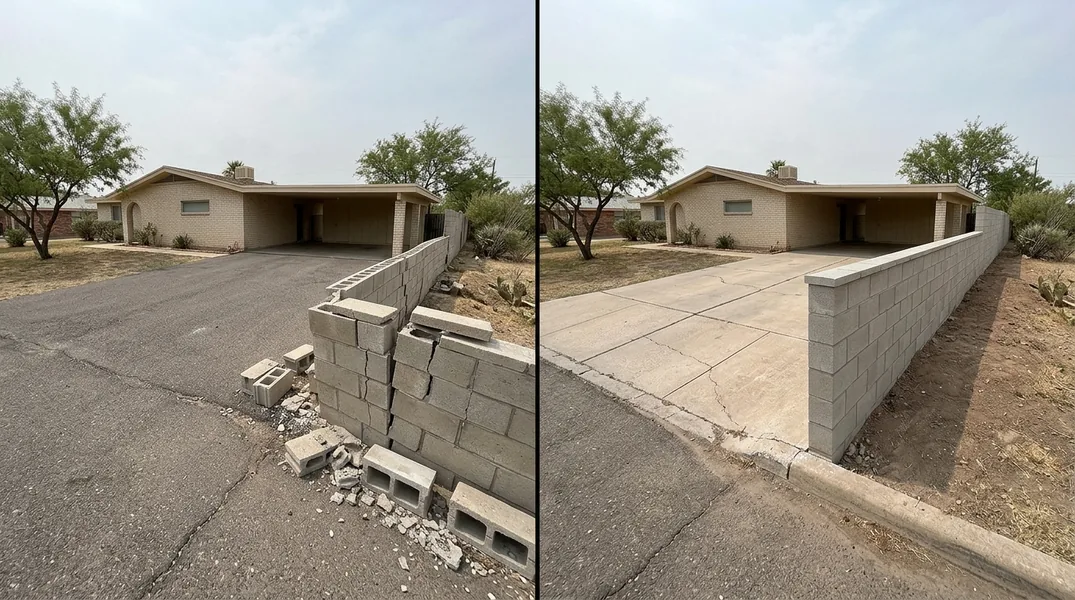
Why Laredo's Clay and Caliche Soils Are Tough on Retaining Walls
If you own property in Laredo, you already know that the ground here is not like the ground in other parts of Texas. The region is dominated by expansive clay and caliche, a hard, calcium carbonate-rich layer that can be surprisingly shallow in some lots. Both materials create serious challenges for any structure that has to hold back soil, and retaining walls are at the top of that list.
Expansive clay swells dramatically when it absorbs water and shrinks just as dramatically when it dries out. During a wet spring or after a heavy summer storm, the clay behind your wall can expand with enormous force. When the dry season returns, that same soil contracts and leaves voids. Caliche adds another layer of difficulty because it can be extremely hard to excavate and drains poorly, so water tends to pool against the wall instead of moving away. Over time, this constant cycle of swelling, shrinking, and trapped moisture pushes and pulls on the wall until something has to give.
The Most Common Reasons Retaining Walls Fail Here
Most failing walls in Laredo share a handful of root causes. The first is inadequate drainage. When water cannot escape through proper weep holes, gravel backfill, and a drain pipe, it builds up hydrostatic pressure behind the wall. That pressure is often stronger than the wall was ever designed to resist. The second is poor foundation preparation. A wall built on soft, disturbed clay or on top of a shallow caliche shelf without the right base can settle unevenly, which starts the leaning process.
The third common cause is underestimating the soil. A wall that would perform fine in sandy ground may be badly undersized for expansive clay, especially if the design did not account for surcharge loads from a driveway, patio, or slope above. Finally, age and deferred maintenance catch up with many walls. Small cracks that nobody notices let water in, and freeze-thaw cycles or simple erosion slowly undermine the base. If you are seeing the results of any of these problems, professional Retaining Wall Repair can often stop the damage before it becomes a full rebuild.
Warning Signs: How to Spot a Leaning or Failing Retaining Wall
A leaning retaining wall is the most visible warning sign, and it is one you should never ignore. Even a slight tilt at the top of the wall means the soil pressure has started to win. Check the wall from a distance and look for a consistent vertical line. If the top leans toward the street, the yard, or a structure, the wall is under stress. Another sign is a bowing retaining wall, where the middle of the wall bulges outward while the ends stay put. Bowing usually points to hydrostatic pressure or a backfill problem, and it tends to get worse quickly once it starts.
Other red flags include horizontal or stair-step cracks in concrete or block, separated joints, soil washing out from around the base, and gates or fences attached to the wall that no longer close properly. You may also notice water pooling behind the wall after rain or muddy seepage at the face. If you spot any of these, do not wait for the next rainy season. A bowing retaining wall fix is far less expensive when it is addressed early. Homeowners in Rio Bravo and El Cenizo face the same soil conditions and should watch for identical symptoms.
Retaining Wall Repair Near Me: When to Call a Professional
Some homeowners try to patch a leaning wall with a fresh coat of paint or a bit of mortar, but cosmetic fixes do not address the soil and drainage problems underneath. If the wall is more than a couple of feet tall, holds up a driveway or structure, or shows any movement at all, it is time for a professional evaluation. A qualified contractor will check the base, the backfill, the drainage system, and the wall's structural capacity. In many cases, targeted repairs such as improving drainage, rebuilding a section, or adding proper reinforcement can extend the life of the wall significantly.
When damage is extensive, Retaining Wall Replacement may be the safer and more economical choice over repeated patches. Modern Concrete Retaining Walls engineered for expansive soils perform far better than older, undersized structures. If you are searching for retaining wall repair near me in the Laredo area, call Laredo Retaining Wall at (956) 606-3937 to schedule an inspection. Getting a professional opinion now can save you from a much larger bill later.
How to Prevent Future Failures on Your Property
Prevention starts with water management. Make sure gutters, downspouts, and surface grading direct water away from the wall rather than toward it. Keep weep holes clear and avoid piling soil or mulch against the face of the wall. If you are planning new landscaping, choose plants with modest root systems and avoid overwatering near the wall, since saturated clay is the enemy. Regular inspections, especially after heavy rains, help you catch small issues before they turn into leaning or bowing.
If you are planning a new wall, proper Retaining Wall Installation is the best defense. That means a design that accounts for Laredo's clay and caliche, a properly compacted base, gravel backfill, and a drainage system sized for the site. Whether you need a new wall or want to protect an existing one, it helps to understand the pricing involved so you can plan. Homeowners in Bruni and across the region can benefit from the same approach. Reach out for a free estimate and get a clear plan for your property.
Looking for a professional retaining wall contractor in Laredo? Laredo Retaining Wall responds fast for all your retaining wall needs.
Get a Free QuoteOur services: Retaining Wall Installation · Retaining Wall Repair · Retaining Wall Replacement